Why Do Astronauts Float in Space if Gravity Still Pulls?

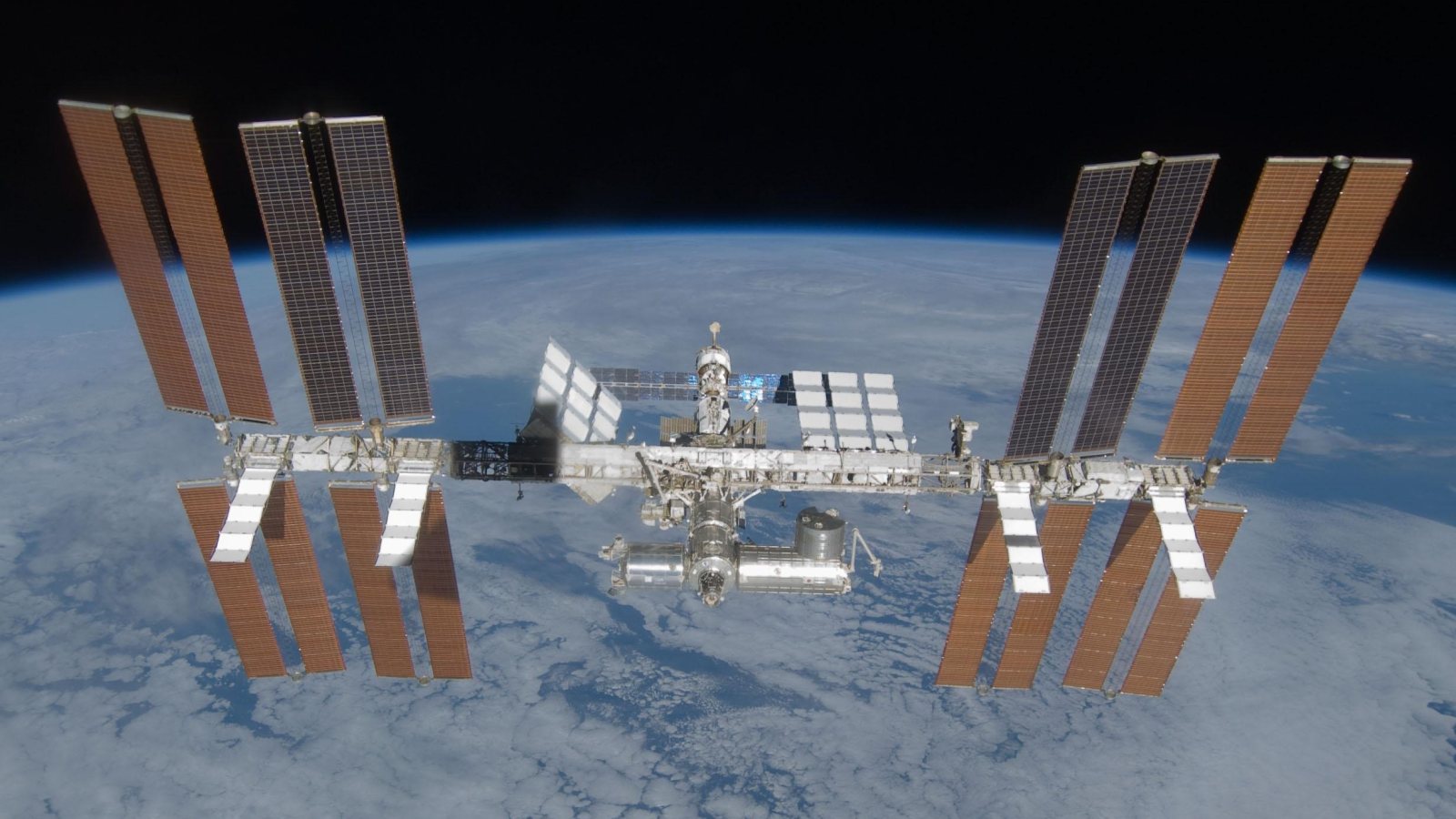
Watch an astronaut let go of a pencil aboard the International Space Station and it may seem as if Earth has stopped pulling on both of them. So why do astronauts float in space? The clue is that the pencil stays near the astronaut, not that it stays still. Both are moving around Earth with the station, and gravity bends all three paths. A bathroom scale in an imaginary elevator gives us a way to tell the difference between gravity pulling on you and what you feel as weight.
What a bathroom scale measures
Stand on a scale while an elevator is stopped. Earth pulls you down, and the scale pushes you up. You push down on the scale with an equal and opposite force to its upward push on you. That contact force is what the scale measures. A scale displaying kilograms converts the measured force into a mass reading; it does not directly measure how much matter you contain.
While you stand still, the scale's upward force must balance the downward force of gravity. If your mass is 60 kilograms and the local gravitational acceleration is about 9.8 meters per second squared, gravity pulls on you with a force of about 588 newtons. The scale pushes up with about 588 newtons, so a typical bathroom scale displays about 60 kilograms. The upward support force is your apparent weight. It happens to equal the force of gravity in this case, but the two forces come from different sources.
A falling elevator can make the scale read zero
Suppose the elevator starts moving downward, accelerating at 2 meters per second squared. Gravity still pulls you down with about 588 newtons, but the scale no longer needs to balance that entire force. To give a 60-kilogram person a downward acceleration of 2 meters per second squared, the net force must be 120 newtons downward. The upward push from the scale is therefore about 468 newtons, and you feel lighter. Once the elevator moves downward at a constant speed, its acceleration is zero and the reading returns to normal.
Now imagine an ideal elevator in free fall, with air resistance ignored. Gravity accelerates you, the scale, and the elevator downward together. The scale does not have to push you to make you follow the floor: gravity already gives you the same downward acceleration. The scale reads zero even though the gravitational force on you is still about 588 newtons near Earth's surface.
You do not need to rise toward the ceiling to be weightless. If you start at rest relative to the floor, you can stay next to it without pressing on the scale. If you release a pencil without giving it a push, it can stay beside your hand while you both descend. From inside, the pencil seems to hang in the air. From outside, it is falling with you.
Why do astronauts float in space instead of falling to Earth?
They are falling toward Earth. Unlike the elevator, though, an orbiting spacecraft has enough sideways speed to keep missing the ground. Picture a ball launched horizontally. Without air resistance, it travels forward while gravity bends its path downward. Launch it faster and it travels farther before reaching the ground. At orbital speed, Earth's curved surface drops away beneath the ball fast enough that the ball can keep falling without hitting it, provided hills and the atmosphere do not get in the way.
In a circular orbit, gravity continuously changes the direction of the spacecraft's velocity without changing its speed. If gravity suddenly vanished, the spacecraft would fly off in a straight line tangent to its orbit, not continue around Earth. Gravity is what keeps the spacecraft in orbit in the first place. NASA's explanation of microgravity uses the same idea of continuous free fall.
Gravity pulls on the astronaut inside the spacecraft as well as on the spacecraft itself. When the astronaut lets go of a handrail without pushing off, the astronaut and the spacecraft already have nearly the same velocity. They also have nearly the same gravitational acceleration. The cabin does not need to hold the astronaut up. A bathroom scale under the astronaut's feet would read nearly zero unless something, such as a strap, pressed the astronaut against it.
Strong gravity and small drifts can coexist
At a height of about 400 kilometers above Earth, gravitational acceleration is still about 89 percent of its value at the surface. You can estimate that with the inverse-square law. Earth's radius is about 6,370 kilometers, so an object 400 kilometers up is about 6,770 kilometers from Earth's center. The ratio of gravitational accelerations is approximately (6,370 / 6,770)2, or 0.89. That reduction is nowhere near enough to explain a scale reading close to zero.
Real spacecraft do not provide perfect free fall everywhere inside. Gravity is slightly stronger on the side closer to Earth, and the direction of its pull varies slightly from one part of a spacecraft to another. Thin traces of atmosphere also exert drag on the spacecraft's exterior. Effects like these can make a released object drift relative to the cabin. The term microgravity describes this environment of near weightlessness; it does not mean that Earth's gravitational field is nearly gone.
Try the scale test in reverse
Take the same 60-kilogram person in an elevator that is still moving down but is now slowing to a stop. Before doing any math, predict whether the scale reads more or less than it did at rest. The direction of motion can throw you off: downward motion with decreasing speed means upward acceleration.
If the acceleration is 2 meters per second squared upward, the net force must be 120 newtons upward. The scale must supply enough force to balance the 588-newton gravitational pull and provide that extra 120 newtons. It pushes up with about 708 newtons. The person feels heavier while still moving down.
For more practice separating motion from the forces that change it, try the IPhyC training and practice problems or browse our Physics Explained articles.
Frequently asked questions
Would a bathroom scale work on the space station?
It can measure a push, but just touching it with your feet won't give your usual reading. You and the scale are falling together, so you aren't pressing on it as you would on Earth.
Does an astronaut lose mass in orbit?
No. Free fall removes the usual support force, not the astronaut's mass.
Can you feel weightless without going into orbit?
Yes. A plane flying a carefully controlled arc can briefly fall with its passengers, leaving them nearly weightless relative to the cabin.